Saturday, August 10, 2024

JD Vance Can't Even Be Authentic In His Nerdom

 (By Hayes Brown, MSNBC, 10 August 2024)

JD Vance on July 22 in Middletown, Ohio.

 Since former President Donald Trump tapped him to be his running mate, Sen. JD Vance, R-Ohio, has become the poster child for the Democrats’ new favorite word — “weird” — as his stiff demeanor and atrocious policy beliefs have been placed center stage. It’s in this harsh spotlight another of Vance’s traits has come to the forefront: He’s a big ol’ nerd. There have been pieces written about his devotion to the classic fantasy series “The Lord of the Rings” and the way it’s shaped his worldview. More recently, he and his wife, Usha Vance, gave interviews talking about his time playing “Magic: The Gathering,” a card game that draws heavily on fantasy tropes.

I want to underscore that these two descriptors — “weird” and “nerd” — are not synonymous. As a card-carrying nerd myself, I would have to say that Vance’s love of stereotypically geeky interests has nothing to do with his creepy tendencies. If anything, he has shown himself to be the worst kind of nerd, one who reinforces the toxic masculinity that was at one point inseparable from overarching geekdom. It is to Vance’s discredit that he will likely be unable to see how deeply his rejection of all things “woke” isolates him from a community that has come to embrace the “good weird” that doesn’t fit into his homogenized vision of America.

Let’s start with Vance’s ties to M:TG (not the GOP congresswoman from Georgia). Earlier this week, an interview with Usha Vance aired on “Fox & Friends,” aimed at helping to soften her husband’s image and defend his now infamous “childless cat ladies” comments. “He has all sorts of dorky interests that anyone of our age could relate to,” she told Fox News host Ainsley Earhardt. Those interests, Earhardt told her co-hosts, include playing the collectable trading card game.

Vance denied that it was a current interest when Semafor asked him about it Wednesday, calling it a “phase.” More interesting, though, was the reason he said he ditched the game:

The big problem with transitioning from being a 13-year-old who likes Magic: The Gathering to being a 15-year-old who likes Magic: The Gathering is that 15-year-old girls do not like Magic: The Gathering. So I dropped it like a bad habit.

He may have meant it as a laugh line, but it speaks to something very real about how gatekeeping has worked in nerd spaces. It’s true that back when Vance would have been playing, as depicted briefly in the movie adaptation of his book “Hillbilly Elegy,” the game was not exactly popular among young women. Even as of 2015, only an estimated 38% of the game’s players were female, according to one of Magic’s designers. But arguably much of that was due to the self-reinforcing habits of male players who would scoff at any girl who could possibly try to compete against them. How many of the 15-year-old girls whom Vance wrote off as having no interest would have been interested in learning how to play alongside him?

It’s only relatively recently that the game’s owner, Wizards of the Coast, itself a subsidiary of Hasbro, has realized how much of the population was being excluded from playing (and buying cards) thanks to the perceived gender norms around the game. Since then, it has moved to eliminate the sexist art that was the norm for the cards’ illustrations and tried to make the game feel more inclusive overall. It’s a shift that of course drew some backlash from the JD Vances of the world.

Beyond this specific issue, I’d argue that Vance is bad at being a nerd, given how deeply he has clearly missed the point of “The Lord of the Rings.” J.R.R. Tolkien’s seminal work was born in part out of his view of the horrors of World War I. It stresses the need for fellowship among different groups against the forces of evil and a rejection of the desire for ultimate power. As The New York Times’ David French and Jamelle Bouie have separately noted, there’s little evidence that those messages sunk in with Vance.

Vance shares that obliviousness with his benefactor, billionaire Peter Thiel, who made his fortune as an early investor in PayPal. After all, Thiel named his giant data analytics company Palantir after the all-seeing orbs that the villains use to spy on the heroes in “The Lord of the Rings.” As a reference, that’s a deep enough cut to really show off one’s geek credentials while displaying exactly zero comprehension about why Thiel’s pursuit of military contracts would be something that the story’s protagonists would frown upon.

We can see this determination to miss the values for the merchandise among many branches of nerd culture. Recently, a post on Reddit’s r/Conservative message board detailed how a group of “Star Trek” fans were appalled to hear politics brought up at a Las Vegas convention. It’s truly a mystery as to how these supposed fans missed the very transparent left-wing tilt throughout the “Trek” franchise, which is set in a post-capitalist utopia where diversity is the greatest of strengths.

Along with this purposeful blindness comes the lack of recognition from Vance and those like him that the nerds have won. Geek culture has become a pop culture Goliath. The most popular franchises in the world have realized that it matters that everyone gets to see themselves in the stories being told. For Vance and others, it’s not their interests in comic books or sci-fi that sets them apart now. What’s weird is their refusal to share that win with anyone who doesn’t fit the outdated stereotype of who and what a nerd is.

Considering who Vance has become, it’s easy to clock the kind of nerd he once was. Over the last eight years, he’s transformed himself from someone who correctly saw Trump as a threat to the country into Trump’s potential vice president. Much like with Magic, he has opted to drop his morals like a bad habit, showing that he’s more than willing to shift and change himself to try to fit in with his chosen in-group. In doing so, he’s become the kind of nerd who has chosen to punch down out of fear of being punched himself.

https://www.msn.com/en-us/news/opinion/jd-vance-can-t-even-be-authentic-in-his-nerdom/ar-AA1oz1An?ocid=msedgdhp&pc=DCTS&cvid=aff3a34aebf94e6ebe672a41328f1a46&ei=27

Saturday, June 8, 2024

Trump's First Term Was A Sh*t Show

 Worse than inflation: Let's remember Trump's real record in office

(By Heather Digby Parton, Salon, 7 June 2024)


                                                      Donald Trump Alex Wong/Getty Images© Provided by Salon

Public opinion polls about the current presidential race are mystifying in a lot of ways. How can it be that the twice impeached, convicted felon Donald Trump is the presumptive nominee for the Republican Party again? As inexplicable as it is to many of us, I think after eight years we have to accept that almost half the country is beguiled by the man while the other half looks on in abject horror and carry on from there. But as much as we may be dismayed by this adoration and fealty to Trump the man, it's still maddening that so many voters — including even Democrats — insist that everything was so much better when Donald Trump was president. I can't believe that people have forgotten what it was really like. By almost any measure it was an epic sh**show. 


One obvious explanation is that Trump lies relentlessly about his record. So after a while people start to believe him. According to Trump, we had unprecedented prosperity, the greatest foreign policy, the safest, the cleanest, the most peaceful world in human history and it immediately turned into a toxic dystopia upon his departure from the White House.  The reality, of course, was far different.

From the day after the election, Trump's presidential tenure was a non-stop scandal. Even in the early days of the transition, there were substantial and well-founded charges of corruption, nepotism and collusion with foreign adversaries. There was the early firing of Trump's national security advisor, the subsequent firing of the FBI director and eventually the appointment of a special counsel. He did manage to set a record while in the White House: the highest number of staff and cabinet turnovers in history, 85%. Some were forced out due to their unscrupulous behavior, others quit or were fired after they refused to carry out unethical or illegal orders ordered by the president. This continued throughout the term until the very last days of his presidency when a handful of Cabinet members, including the attorney general, resigned over Trump's Big Lie and refusal to accept his loss. 

Yes, those were really good times. Let's sign on for another four years of chaos, corruption and criminality.

But, let's face facts. What people think they miss about the Trump years was the allegedly great pre-pandemic economy and the world peace that he brought through the sheer force of his magnetic personality. None of that is remotely true. The Trump economy was the tail end of the longest expansion in history begun under President Barack Obama and the low interest rates that went with it. Nothing Trump did added to it and he never lived up to even his own hype:

Trump assured the public in 2017 that the U.S. economy with his tax cuts would grow at “3%,” but he added, “I think it could go to 4, 5, and maybe even 6%, ultimately.”If the 2020 pandemic is excluded, growth after inflation averaged 2.67% under Trump, according to figures from the Bureau of Economic Analysis. Include the pandemic-induced recession and that average drops to an anemic 1.45%. By contrast, growth during the second term of then-President Barack Obama averaged 2.33%. So far under Biden, annual growth is averaging 3.4%.

Inflation started its rise at the beginning of the pandemic (Trump's last year) and continued to rise sharply in the first year of the Biden administration before it started to come back down. The reasons are complex but the fact that it was lower under Trump is simply a matter of timing. Trump's economy was good but it wasn't great even before the pandemic. He had higher unemployment than we have now, he blew out the deficit with his tax cuts and his tariffs accomplished zilch. Sure, the stock market was roaring but it's even higher now.

Unlike Trump, who simply rode an already good economy, Biden started out with the massive crisis Trump left him and managed to dig out from under it in record time. No other country in the world has recovered as quickly and had Trump won re-election there's little evidence in his record that he could have done the same. All he knows is tariffs and and tax cuts and he's promising more of the same. 

On the world stage, he was a disaster. From his ill-treatment of allies to his sucking up to dictators from Kim Jong Un to Vladimir Putin, everything Trump did internationally was wrong. He was impeached for blackmailing the leader of Ukraine to get him dirt on Joe Biden, for goodness sakes! Does that sound like a sound foreign policy decision? The reverberations of his ignorant posturing will be felt for a generation even if he doesn't win another term.

And despite the alleged peacenik's boast that he never had a war while he was president, it's actually a lie. The US had troops in Afghanistan fighting throughout his entire term despite his promise to withdraw and there was a very ugly drone war carried out throughout his term. Trump bombed Syria and assassinated Iranian leaders and did all the things American presidents had been doing ever since 9/11. His only answer today to the vexing problems that are confronting Biden in Ukraine and Israel is to fatuously declare "it never would have happened" if he were president. On Gaza, Trump's solution is "finish the problem" and I don't think there's any question about what he means by that. 

Trump's labor record was abominable, his assaults on civil rights and civil liberties were horrific and he did nothing positive on health care. There was the Muslim ban, family separations, the grotesque response to the George Floyd protests and the rollback of hundreds of environmental regulations. And then there was January 6.

Trump, who called himself the greatest jobs president in history, was the first president since Herbert Hoover during the Great Depression to depart office with fewer jobs in the country than when he entered. He can say that doesn't count because of the pandemic but so much of that was his fault that it actually is. It was his crucible and he failed miserably.

His administration had disbanded the pandemic office and failed to replenish the stockpiles of medical supplies so we already started out ill-prepared. He denied the crisis at first, and we learned from Bob Woodward's interview that he knew very well how deadly it was, he lied, he put his son-in-law and some college buddies in charge of logistics. He pushed snake oil cures and disparaged common sense public health measures because they threatened his desire for a quick economic revival despite the fact that Americans were dropping dead by the thousands every single day. And, as always, he blamed everyone else for his problems. COVID killed far more Americans than other peer nations and it was due to Trump's failed leadership. 

For all these reasons, anyone who looks back on the Trump years as a golden time when everything was so much better isn't remembering the reality of those four awful years. There are worse things in life than inflation.

https://www.msn.com/en-us/news/politics/worse-than-inflation-let-s-remember-trump-s-real-record-in-office/ar-BB1nOxnr?ocid=entnewsntp&pc=DCTS&cvid=241a30e25bca448281df2e5e79b4795b&ei=24

Saturday, December 9, 2023

The Biggest ‘Greedflation’ Study Yet Looked At 1,300 Corporations. Many Were Lying To You About Inflation.

 (Story by Ryan Hogg, Fortune.com, 8 December 2023)

As they rolled their eyes at the frustratingly familiar sight of price markups on grocery store aisles, the shopper of 2022 might have wondered whether corporations were doing everything they could to keep prices down as inflation hit generational highs. The answer now appears to be a resounding no. 

A joint study by the think tanks IPPR and Common Wealth found profiteering by some of the world’s biggest companies forced prices up significantly higher than costs during 2022.

Greedflation

Inflation soared across the globe last year, peaking near 11% in the Eurozone and above 9% in the U.S.

The source of that high inflation has become a well-trodden line. Analysts have typically laid the blame on supply chain bottlenecks created by excess demand during the COVID-19 pandemic and exacerbated by Russia’s invasion of Ukraine.

The war also increased energy prices, leading to further rises in inflation as suppliers factored in higher transport and running costs.

While this obviously contributed to rising prices, the report finds that company profits increased at a much faster rate than costs did, in a process often dubbed “greedflation.”

Profits for companies in some of the world’s largest economies rose by 30% between 2019 and 2022, significantly outpacing inflation, according to the group’s research of 1,350 firms across the U.S., the U.K., Europe, Brazil, and South Africa.

Inflation: What goes up doesn’t always come down

In the U.K., the research found that 90% of profit increases occurred among just 11% of publicly listed firms. Profiteering was more broad in the U.S., where a third of publicly listed firms were responsible for most of the increase in profits.

The biggest perpetrators were energy companies like Shell, ExxonMobil, and Chevron, who were able to enjoy massive profits last year as demand moved away from Russian oil and gas. 

Food producers including Kraft Heinz realized their own profit surges. The war in Ukraine rocked global grain supplies and fertilizer prices, significantly increasing the cost of food, which remains sticky. 

The findings add to a growing body of research seeking to highlight the role of major businesses in forcing up inflation last year. 

A June study by the International Monetary Fund (IMF) found that 45% of Eurozone inflation in 2022 could be attributed to domestic profits. Companies in a position to benefit most from higher commodity prices and supply-demand mismatches raised their profits by the most, the study found.

CEOs of the world's biggest companies consistently sounded the alarm on inflation as a significant barrier to growth. Many blamed rising input costs on their own price hikes. However, lots of those CEOs appear to have instead used the panic of rising costs to pump up their balance sheet.

In April, Société Générale economist Albert Edwards released a scathing note saying he hadn’t seen anything like the current levels of corporate greed in his four decades working in finance. He said companies were using the war in Ukraine as an excuse to hike prices in search of profits.

“The end of Greedflation must surely come. Otherwise, we may be looking at the end of capitalism,” Edwards wrote. “This is a big issue for policymakers that simply cannot be ignored any longer.”

Prices coming down

Inflation is now beginning to regulate in most major economies and coming closer to most Central Banks’ targeted 2%. Some companies that previously passed rising costs onto customers to continue making a profit have now sought to repay them with price cuts.

Last week, Ikea stores owner Ingka’s deputy CEO said the company would be spending $1.1 billion to absorb inflation and bring down the prices of goods in its stores.

“People have thin wallets, but they still have needs, dreams, and frustrations,” Juvencio Maeztu told Fortune.

In November, Walmart CEO Doug McMillon suggested the era of high inflation in the U.S. was over, and shoppers may soon begin to experience a contraction in prices—known as “deflation”—in company stores.

https://www.msn.com/en-us/money/other/the-biggest-study-of-greedflation-yet-looked-at-1-300-corporations-to-find-many-of-them-were-lying-to-you-about-inflation/ar-AA1lcmku?ocid=entnewsntp&pc=DCTS&cvid=6fbb3fd382af417fa0e50f8798e3f4a6&ei=39

Sunday, July 24, 2022

Is 'wokeness' responsible for US and European heat waves? Absolutely.

 With record temperatures steam-pressing the United States and much of Europe, Africa and Asia, many in my Science-Is-A-Hoax Facebook group have posed a sensible question: Is "wokeness" to blame for these heat waves?

As a white man with access to the internet and an unwillingness to care about anyone besides myself, I can tell you the answer is, indisputably, yes. Liberal wokeness is causing temperatures to rise and forcing me to leave my Hummer idling in the driveway with the AC on and the doors open in an attempt to cool the air around my house.

President Joe Biden and his windmill-hugging liberal minions will tell you the soaring temperatures have something to do with “climate change” or “global warming” or “humanity’s unwillingness to stop destroying the planet, thereby guaranteeing its own extinction.”  Well, if you believe that, I have a coastal bridge to sell you! (FULL DISCLOSURE: Bridge is currently underwater and will require minor heightening and repairs.)

On Tuesday, the National Weather Service, which notoriously attempts to influence conservatives with left-wing concepts like “facts” and “data,” forecast “dangerous heat” across the country, ranging from the high 90s to triple digits. 

In a heat advisory, the Weather Service wrote: “Take extra precautions if you work or spend time outside. When possible reschedule strenuous activities to early morning or evening. Know the signs and symptoms of heat exhaustion and heat stroke.”

You don’t get to tell me what to do, you Marxist meteorologists. I’m an American, and if I want to go out in the backyard and dump used motor oil in the pond while breathing in the welcoming smoke of my neighbor’s tire fire, I will do so without knowing the signs and symptoms of heat exhaustion, thank you very much. Commies.

Now back to why wokeness is to blame for the heat, and for everything I don’t want to be forced to care about.  Wokeness is an effort to get a person like me to treat people who aren’t exactly like me with some level of basic human decency, usually through onerous requests like respecting their identity or faith, not making offensive jokes at their expense or having to make almost immeasurably small adjustments to the way I speak or live my life.

It could involve a person saying, "I use he/him pronouns and would appreciate you using them when you refer to me," and me saying, "That would require me to be considerate, and I can't do that because my brain is busy figuring out new ways to 'own the libs' on Twitter."

Or it could involve a teacher giving my child the historical context of racism in America so he can grow up with a full understanding of our nation's complicated past, when I would prefer that teacher stick to the teachings of Sean Hannity, who once said: "The U.S. is the greatest, best country God has ever given man on the face of the earth.“

When confronted with wokeness, I have two options: Listen, understand and do my best to make another person’s life better (HAH!); or get extremely angry and vent about it online.

Obviously, I always choose the second option, which is bad for global temperatures because getting angry online causes my brain to start functioning, and the friction involved in firing dormant synapses generates SERIOUS heat.

Now imagine how many of me there are in this country and around the world and how much heat our brains are cranking out when we get angered by woke-ism. Is that enough to explain why the United Kingdom shattered its previous high-temperature records on Tuesday, with one village in eastern England hitting 104.5 degrees Fahrenheit?

No, not quite. The other woke-induced issue contributing to these heat waves is the voluminous hot air released by Republican politicians and right-wing pundits when they are angry about wokeness, which is all the time.

Republican Sen. Ron Johnson of Wisconsin recently released a weather-changing blast of hot air when he blamed school shootings like the one in Uvalde, Texas, on wokeness: “We stopped teaching values in so many of our schools. Now we’re teaching wokeness, we’re indoctrinating our children with things like CRT, telling some children they’re not equal to others, and they’re the cause of other people’s problems.”

Nikki Haley, former U.S. ambassador to the United Nations and possible GOP presidential candidate, spiked the room temperature in Fox News’ studio Tuesday, saying America needs to "get rid of all this woke stuff” and start fighting for “normal people.” 

Do you see the harm you’re doing to the environment, you woke warriors? You’re causing people like Haley to warm the earth’s atmosphere with fired-up comments suggesting you’re not normal. Should she have kept that thought to herself and never admitted she had it to anyone, anywhere, ever? Yes. But you folks in the “let’s all take the infinitesimally small measures necessary so everyone can be their true selves” crowd forced Haley to say it out loud in a billowing puff of hot air and now WE HAVE FLIGHTS GETTING CANCELED BECAUSE AIRPORT RUNWAYS ARE MELTING!!

Shame on all of you for trying to force us normals to think about someone other than ourselves. You woke-ists have nobody but yourselves to blame for these heat waves.  Either that or I typed this column outdoors by the tire fire without knowing the signs and symptoms of heat exhaustion.

https://www.msn.com/en-us/news/opinion/is-wokeness-responsible-for-us-and-european-heat-waves-absolutely/ar-AAZMHNs?ocid=entnewsntp&cvid=c99e491693c84d17b89a2463959b05a6 

Saturday, June 11, 2022

School Shootings: One Of My Students Asked If I’d Stand Between Them And A Gunman. Here’s What I Said.

 (By Amanda Mayes, Huff Post, 30 May 2022)

 “Ms. Mayes? If a gunman came in here, would you protect us? Would you stand between us and the gunman?”  It was about two months into my third long-term substitute teaching position at my high school alma mater. I returned when my high school mentor was diagnosed with cancer. When he came back in remission, I stayed to continue to build and shape the community that had given me a sense of self in my formative years.

This group of students was still new to me, but I adored them. Sure, they had their moments when they would rather be sucked into a phone screen than discuss the ramifications of gerrymandering, the intricacies of supply and demand, or the Gilded Age.

But teenagers deserve more credit than we ever give them.

They are kind, intelligent, insightful and bold. I was supposed to be their teacher, but I learned so much about myself and the world from them. When they are of age to vote, they will ignite this world with compassion. We do not deserve them, especially when we continuously fail to protect them.

That day, I was running my first active shooter drill.

When I sat in these same desks and walked down these same halls six years earlier, the only scenarios we rehearsed were for tornadoes, fires, and asking a special someone to prom.

But this is the new normal. My students were restless. It was a planned drill ― not always a given, as some drills are enacted without warning. But the notice did little to calm nerves and suppress the reality that we must rehearse for the possibility of our own deaths.

I reviewed my lesson plan, glared at the finicky overhead projector, took a sip of coffee, and waited. No one knew when the principal’s voice would come over the intercom, triggering the drill.

The drill came and went, and melted into the new normalcy of a modern school day, with full knowledge that our paper-thin classroom walls were no match for automatic weapons fire.

But this is not normal. This should not be normal.

We ask our teachers to do so much — to be educators, caregivers, counselors, nurses, peacekeepers, custodians, disciplinarians. And now we ask them to be human shields.

When I stumbled into teaching, it had not crossed my mind that I would have to grapple with my own mortality and weigh the worth of my life against those of my students, despite growing up in this era. I was in third grade when Columbine stunned the world of education. I was in 11th grade when the Virginia Tech shooting happened.

“Yes. Yes, of course I would,” I told the teenager who had asked if I would protect my students.

I made the decision to sacrifice myself to save my students should an active shooter enter my classroom. Part of teaching is believing in the future and believing in a better future. My students must survive to make that future a possibility.

But it is not a decision I should have to make.

With each new mass shooting, the arguments against common-sense gun restrictions appear like clockwork:

“If we armed the teachers, this wouldn’t happen.”

I am an educator. A mentor. A helper. A guide. A light. I will not be relegated to a role of perpetuating this American culture of violence. I will not be complicit in the weaponization of myself and my fellow teachers.

“This is the price we pay for our Second Amendment freedoms.”

Why have many in this country decided that owning weapons outweighs the safety and lives of our children and teachers? How many dead students and dead teachers is your “freedom” worth to you? How high are you willing to set the price to defend an amendment that has been outpaced by technology? How is worrying about being shot at school or a movie theater or a grocery store freedom? Your paranoia and misguided belief that “courage is a man with a gun in his hand” has corrupted the original intent of an antiquated amendment.

We accept reasonable limitations to our other rights. Why is this such a struggle with the right to bear arms?

“Guns don’t kill people; people kill people.”

It is beyond time to limit access to tools used to kill more efficiently. Why are you so terrified of your neighbor that you need an assault rifle? Or feel the need to conceal and carry when you do your weekly grocery shopping? This is a reflection of you — of your need for false power, of your suspicions, of your cowardice — not a reflection of the society you purportedly fear. An AR-15 or other military-grade weapon serves no purpose other than that of destruction.

“This is an act of a mentally ill person.”

Stop equating mental illness as a requisite for murder. Start supporting mental health care. Start normalizing discussion about mental health. Start considering the mental health of those affected by gun violence.

“Now is not the time for politics. Now is the time to send thoughts and prayers.”

Thoughts and prayers comfort those left behind. They also assuage the consciences of those who plan to do nothing, who will continue to support the status quo because it is comfortable, familiar, and politically expedient.

These days I occasionally teach political science as an adjunct at a college. Every classroom I enter triggers the same process: Check the door. Take note of how it locks. Plan how to cover the windows. Find potential barricades. Make a plan. Rehearse.

This process is more difficult at a college because the classroom is not mine. It is used by several faculty members throughout the day. Desks arrangements may be reconfigured. The blinds may be opened or closed. Keys may be misplaced. A first aid kit may have vanished to another room.

Each time the classroom could be different, which necessitates quickly generating a new plan. I have lost sleep running different scenarios in my mind to be prepared for the next day.

Creating a plan in case of an active shooter is second nature now. It is part of the process. Along with preparing my lecture notes and stashing my best dry erase markers, I think of ways to save the lives of my students.

This should not be normal.

Instead of asking teachers to take on the impossible, to accept the reality that they could die doing their job, ask yourself: Who would have to be gunned down in your life for you to act?

Yes. I will sacrifice my life for the lives of my students. But do not let this become my reality the next time I teach.  Do not let my life and the lives of my students fade into statistics.

https://www.huffpost.com/entry/teachers-school-shootings-uvalde-texas_n_6293d1c7e4b05cfc269bee94?ncid=APPLENEWS00001

Wednesday, May 25, 2022

School Shootings: The GOP’s Only Answer To School Shootings Didn’t Help In Uvalde, Texas

(By Alex Yablon, Slate, 25 May 2022)

 In the recent annals of American political rhetoric, there have been few more consequential statements of ideology than NRA chief Wayne LaPierre’s post–Sandy Hook truism that “the only thing that stops a bad guy with a gun is a good guy with a gun.”  The line has gone from crisis PR spin to Republican Party dogma. But while the “good guy with a gun” mantra has the ring of tough guy common sense, the empirical evidence suggests armed cops and civilians do less than nothing to deter mass shooters.

Look no further than Texas Republicans’ responses to this week’s mass shooting in the small town of Uvalde, the deadliest at an elementary school since Sandy Hook. Speaking to Newsmax, Attorney General Ken Paxton, the top law enforcement and public safety officer in the state, said: “We can’t stop bad people from doing bad things. … We can potentially arm and prepare and train teachers and other administrators to respond quickly. That, in my opinion, is the best answer.”

Top of Form

Bottom of Form

Of course, this is Texas. It’s not like potential good guys with guns were thin on the ground in Uvalde. Law enforcement actually engaged the shooter before he got into the elementary school. Indeed, as the Austin American-Statesman reported, it was actually a school guard—a good guy with a gun—who confronted and failed to prevent the shooter’s entry. For years, though, Texas has encouraged teachers to pack heat. In the wake of a 2018 shooting at a high school in Santa Fe, Texas, Gov. Greg Abbott signed legislation that encouraged schools to do exactly what Ken Paxton now demands. It mattered little back then that Abbott was responding to killings at a school that already had two armed guards and a plan to put guns in the hands of teachers.

As Republicans like Abbott and Paxton double down on the same pro-gun proliferation response to every mass shooting, evidence accumulates that weapons are rarely effective means of deterring or stopping mass shootings.  Last year, a group of public health scholars published a study in the Journal of the American Medical Association examining 133 school shootings from 1980 to 2019. An armed guard was present in about a quarter of the incidents in the study. Those schools actually suffered death rates nearly three times higher than schools without armed guards. Similarly, a 2020 review of gun policy research by the RAND Corporation think tank found no evidence that the presence of more guns had any effect on gun violence. Criminologists at Texas State University found that unarmed staff or the shooters themselves are far more likely to bring a school shooting to an end than someone with a gun returning fire.

So-called good guys with guns fail to effectively deter or end mass shootings for a variety of tactical and psychological reasons.  For one thing, it’s actually very hard to shoot straight in a situation like a mass shooting. RAND analysts have found that even highly trained NYPD officers only hit their intended target in 19 percent of gunfire exchanges. Winning a gunfight with a shooter only becomes more difficult when the perpetrator carries a semi-automatic rifle like an AR-15, as the Uvalde suspect and many others have done. These weapons have a much longer range and are far more accurate than the kinds of pistols typically used by police and civilian concealed carriers, allowing shooters to keep responders far enough away that their own weapons will be of little use. The Uvalde gunman, for instance, managed to overpower two officers whom he encountered on his way to the elementary school.

In the most extreme cases, a single gunman with a semi-automatic rifle can stymie an entire SWAT team for hours: Back in 2015, a single gunman assaulting a Colorado Springs Planned Parenthood with an AK-style rifle held off police for the better part of a day before surrendering.  The idea that armed guards and teachers could deter shootings in the first place presumes mass shooters behave rationally, weighing risks, when in fact the opposite is true. As the JAMA authors noted, “many school shooters are actively suicidal, intending to die in the act, so an armed officer may be an incentive rather than a deterrent.”  Considering the long odds of taking down a determined shooter equipped with an assault rifle, armed police and bystanders sometimes have difficulty motivating themselves to actually engage at all, as happened so infamously in the Parkland shooting when two sheriff’s deputies apparently hid from the gunman.

So Republicans’ preferred response to mass shootings operates in the realm of fantasy. The standard-issue liberal response—to ban guns in a country where they outnumber people—is at this point not much more realistic. That’s not to say there is no way to prevent a lot of mass shootings, however.  Civil gun seizure orders, known as “red flag” laws, are a promising but underutilized means of preemptively intervening when gun owners show signs they will hurt themselves or others. If a gun owner makes a threat or behaves dangerously—committing violent misdemeanors or torturing animals, for example—“red flag” laws allow family, school workers, medical professionals, and law enforcement to petition a judge for an emergency temporary order confiscating the dangerous person’s weapons.

The laws function like more commonplace personal restraining orders. Many states created civil gun seizure procedures in the wake of the 2018 Parkland shooting (though not Texas), and the NRA even offered limited support for the measures. A 2019 case study of California’s law, passed in the wake of the 2014 Isla Vista shooting, found the orders were used in 21 cases where gun owners had made credible threats of mass shootings. It’s at least conceivable that this law prevented other possible atrocities.

Good guys with guns fail to stop bad guys with guns in the moment because mass shootings are rare, surprising, and unpredictable events. Red flag laws are effective because mass shooters are, by contrast, pretty predictable: They almost always display clear warning signs that they are a danger to society and themselves. The Uvalde shooter was no exception: According to friends, he engaged in self-harm, shot a BB gun at strangers, and expressed a desire to kill. He also posted frequently on social media about his desire for guns. If Texas had the appropriate legal machinery in place, the people in the shooter’s life who had been so alarmed by his behavior might have had an opportunity to act before it was too late.

https://slate.com/news-and-politics/2022/05/gop-school-uvalde-shooting-response-guys-with-guns.html

Sunday, January 30, 2022

Why Did Spotify Choose Joe Rogan Over Neil Young? Hint: It’s Not A Music Company

(By Travis M. Andrews, Washington Post, 28 January 2022)


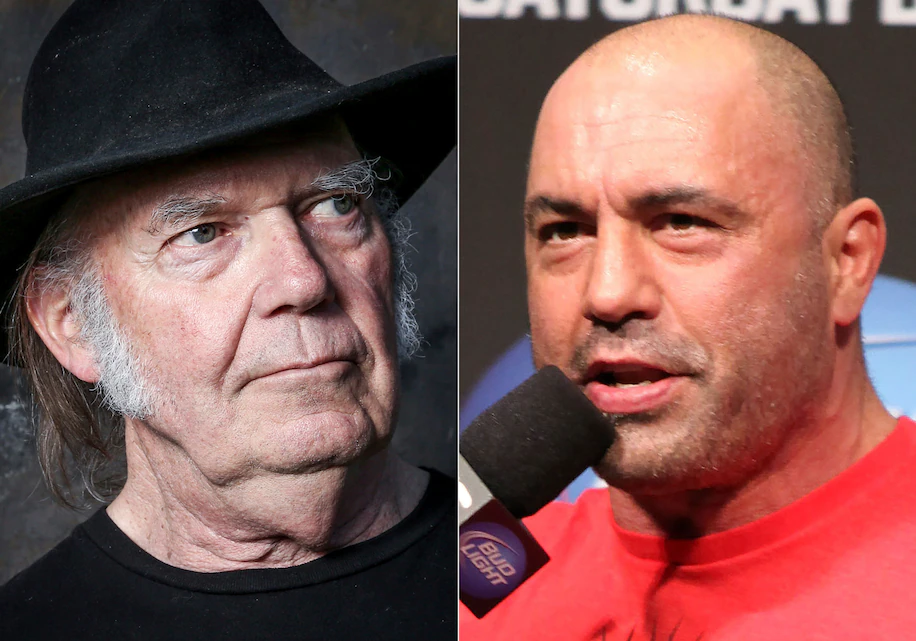
Neil Young, left, and Joe Rogan. (AP)

In one corner was Joe Rogan, the stand-up comedian and former “Fear Factor” host turned provocative podcaster.  In the other stood Neil Young, the multi-Grammy-winning rock legend with a lifelong passion for progressive causes.  The battle lasted two days, and Rogan won without making a peep.

Young started the scuffle when he posted a letter to his website Monday, addressed to his manager and an executive at his record label, demanding that his music catalogue be removed from Spotify in response to “fake information about vaccines.”

Specifically, Young cited Joe Rogan — who hosts “The Joe Rogan Experience” podcast — and has suggested healthy, young people shouldn’t get vaccinated. After catching the coronavirus, Rogan also praised ivermectin, a medicine used to kill parasites in animals and humans that has no proven anti-viral benefits. “I want you to let Spotify know immediately TODAY that I want all my music off their platform,” he wrote. “They can have Rogan or Young. Not both.”

Two days later, without a word from Rogan, Spotify began the process of removing the famed rocker’s music, including his best-known hits such as “Heart of Gold,” “Harvest Moon” and “Rockin’ in the Free World.”  The speed of Spotify’s decision to sideline Young was jarring. So why did the company do it?  The answer is simple: This isn’t really a story about Rogan or Young. It’s a story about Spotify. And, despite public perception, Spotify isn’t a music company. It’s a tech company looking to maximize profits.

Spotify’s quest to dominate the podcast space

The company hasn’t been shy about its desire — in 2019, Spotify announced it was planning to spend up to $500 million to acquire companies “in the emerging podcast marketplace.”  That year it purchased Gimlet Media, home of podcasts such as “Reply All,” “Homecoming” and “Where Should We Begin? With Esther Perel,” for an estimated $230 million. It also spent more than $100 million on Anchor, a platform that lets users create and share their own podcasts.

The next year, Spotify spent nearly $200 million to acquire the Ringer and its suite of popular podcasts, such as “Binge Mode,” “The Press Box” and its founder’s “The Bill Simmons Podcast.” And, of course, it reportedly spent more than $100 million to acquire exclusive rights to a single show: the extremely popular, rabble-rousing “Joe Rogan Experience.”  “I think it comes down to, just frankly, business,” said John Simson, the program director for the business and entertainment program at American University. “In the music side of things, [Spotify is] paying out roughly 70 percent of all the revenue that comes in. It goes right back out as royalties. They’re looking for other places where the revenue split isn’t that dramatic. … Podcasts were certainly their go-to.”

The plan seems to be working. Spotify reportedly overtook Apple Podcasts last year to become the largest podcast provider in the United States.

Spotify’s strained relationship with musicians

As Spotify built its podcasting empire, it has been increasingly criticized by the musicians who use the platform. In December, rapper T-Pain tweeted a breakdown of how many streams it takes for a musician to make $1 on various services, pointing out that on Spotify it takes 315 while on Apple Music it’s 128. Several months earlier, artists and music industry workers, organized by the Union of Musicians and Allied Workers, protested outside Spotify offices around the world — bringing petitions signed by more than 28,000 people that were demanding, among other things, higher payouts for artists.

“I don’t think of any of these platforms as being music companies that actually care about music. I think of them like technology companies,” said Gabriel Teodros, a Seattle-based hip-hop artist who wrote a viral Substack blog in December titled “There’s no money in streaming.”  Even so, Teodros said he was surprised at the “swiftness” with which Spotify decided to remove Young’s music, rather than Rogan’s podcast. “I thought it might be a long, drawn-out thing.”

Other big-name artists have also feuded with Spotify — Taylor Swift pulled her music from the platform until it met her demands — but none seemed to spark widespread change. That leaves Teodros wondering if Young’s protest is “going to be a moment where public perception of public streaming platforms are forever altered, or is it just a blip?”

Young has received an outpouring of support from across the political and social spectrum: “I’m with #NeilYoung,” tweeted Geraldo Rivera. “Waiting on all the musicians to step up and back Neil Young. Where are you?” tweeted author Don Winslow.  It’s not that dropping Young won’t inflict any pain on Spotify. Most of his music is more than 18 months old, and older tunes have become popular during the pandemic. 

So it should come as no surprise that the day after Spotify announced the removal of Young’s catalogue, SiriusXM said it would revive “Neil Young Radio,” a channel dedicated to Young’s music and storytelling, for a brief stint.  “When you have an opportunity to present an iconic artist still at the height of his creativity, you don’t hesitate to do it, again,” Steve Blatter, the company’s senior vice president and general manager of music programming, said in a pointedly cheeky statement. “Outspoken, brave, and a true music icon, Neil Young is in a rare class of artists, and we are honored to collaborate with him to create a special audio experience for his fans.”

Young’s plea to other musicians

“I sincerely hope that other artists and record companies will move off the SPOTIFY platform and stop supporting SPOTIFY’s deadly misinformation about COVID,” Young wrote on his blog on Wednesday.  Whether anyone will follow remains to be seen. Many of the artists who could take up his battle cry — elder statesmen of rock with large enough catalogues to hurt the streaming service — no longer own their own music.  In the past few years, Bruce Springsteen, Bob Dylan, Paul Simon, Tina Turner, Stevie Nicks, the David Bowie estate and many, many more have sold their entire catalogues for large sums. Younger artists, including John Legend and Ryan Tedder, have begun joining in.

In most of these cases, the artist sold both the publishing and the recording copyrights. That means, unless they have a special clause around how their music is used, they don’t have any power to dictate where their tunes appear. And Simson, the American University professor, said such clauses are rare. “The reason [these companies] are paying all that money is that these streaming services are driving up value” of those catalogues.

In his blog post, Young wrote that removing his music from Spotify will equate to “losing 60% of my world wide streaming income.”  So while other artists — particularly his contemporaries — rallying around the legend and pulling their music from the platform might sound like a nice rock-and-roll idea, it’s probably not going to happen.

Is losing one artist enough to force Spotify to change?

Then there’s the question of how much impact a single artist can have. The numbers look staggering. The Weeknd, an extreme outlier, currently garners 86.6 million monthly listeners. Adele has 60 million. Drake has about 53.6 million monthly listeners. Taylor Swift has about 54 million; BTS has 42.3 million.

If one or two of them pulled their music, how many of Spotify’s 172 million subscribers would actually delete their accounts? How many of its 381 million monthly users would stop listening?  “Spotify is probably counting on the inertia aspect. Once you’re on a particular streaming platform, you’re likely to stay there because you’ve got your playlists, you’re familiar with it,” Simson said. “It just feels scary to all of a sudden have to move.”

And those are just the top artists. What about everyone else? As Eve 6 frontman Max Collins sarcastically tweeted, “if spotify doesn’t take neil young seriously i bet they’ll heed the demands of eve6.”

Now consider that Rogan has an estimated 11 million listeners per episode. He usually posts four to five of them each week, and they frequently last longer than three hours.  When Spotify bought Rogan’s podcast, Stephanie Liu, an analyst with the research firm Forrester, told the New York Times, “This is part of Spotify’s bigger bet on podcasts. Spotify is buying not only Joe Rogan’s extensive and future content library, but also his loyal audience.”

To retain that audience, they need Rogan. Plus — and this is key — he’s exclusive to Spotify. Very few musical artists are. Neil Young’s albums are on Amazon, Apple and several other services. Rogan’s library is only on Spotify. You don’t need Spotify to listen to Young, but you do need it to listen to Rogan.

The power of Joe Rogan

“If podcasting is Spotify’s biggest strategic bet, then Joe Rogan is the biggest piece of that,” said Tatiana Cirisano, a music industry analyst and consultant at MIDiA Research. “Other podcasters might be looking at this and wondering, ‘Is Spotify safe for what I want to say?’ ”  She added that while Rogan’s audience may be large, it’s also narrow. His audience skews young and male. He plays the role of provocateur, beholden to no political belief system. While that obviously appeals to his fans, it’s unlikely those who don’t agree with him are tuning in.

“It’s a lot easier to serve a huge audience of music fans than it is to serve a huge audience of podcast listeners. [A] music genre isn’t a polarizing thing,” Cirisano said, adding that while people may listen to various genres of music, they’re much less likely to listen to podcasts across the political spectrum.  Losing an artist doesn’t necessarily mean losing all the fans of that artist. But lose Rogan, and his listeners aren’t likely to switch to Michelle Obama’s podcast, which is also on Spotify.

Joe Rogan is using his wildly popular podcast to question vaccines. Experts are fighting back.

Cirisano said this could be a “crucial moment” for Spotify, and that Young had forced them to choose between two influential talents.  She is, however, doubtful that Young’s move will persuade many people to quit Spotify.  “I think it takes a lot for people to switch platforms,” Cirisano said. “I’m not sure if anyone aside from the top 1 percent of Neil Young stans are going to do that.”

https://www.washingtonpost.com/arts-entertainment/2022/01/28/spotify-joe-rogan-neil-young/